IMAGINE – you’re four rope-ladder pitches down, 43 m (140 ft) underground, and 200 m (650 ft) along in Gingling Hole, a pothole which is known to flood. Even the entrance is 469 m (1,550 ft) up on Fountains Fell, over a mile and a half from a road. If you can afford them, you’re wearing nailed boots, tweed trousers, a Norfolk jacket and probably using a candle tucked into the band of your trilby hat for lighting. The ladder you used to descend is made from natural fibre rope with wooden rungs. An accident here could have very serious implications, for it’s October 1934, there is no such thing as a rescue team, it will be two more years before Settle’s St John Ambulance Brigade has a motor ambulance and almost 14 years to the founding of the NHS.
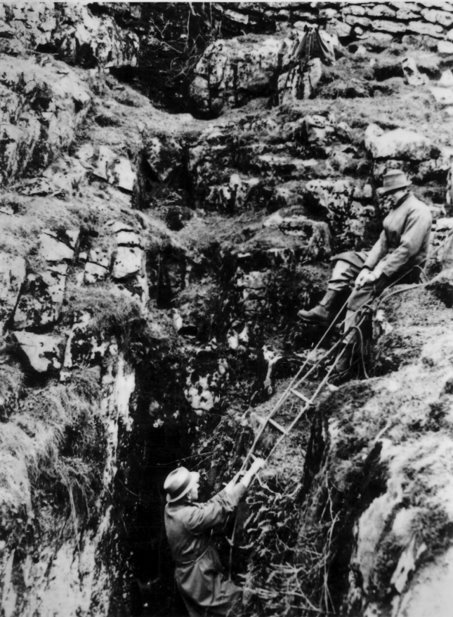
For Reg Weetman, Secretary of the Moor & Fell Club, from York, that imagined scenario must have become an all-too-real, nightmare experience when he dislodged a boulder which broke his leg in two places. Although he was in a strong party of nine, it was clear that serious help would be needed, so while his leg was splinted with a camera tripod, one member exited the hole and went for help. Potholers from other clubs were alerted and with support from the farmer at Rainscar, who supplied the timber for a stretcher and better splints, began to organise a rescue in foul Pennine conditions. A local doctor provided pain relief and was, eventually, allowed to make his first ever pot-holing trip which included setting the casualty’s leg in a plaster cast, while he lay on his side in a low-roofed stream passage.
Some 30 hours after his accident, Reg Weetman arrived at the hospital in Skipton.
(For more, see the websites of Yorkshire Ramblers’ Club – www.yrc.org.uk and Craven Pothole Club – www.cravenpotholeclub.org .)
Settle Ambulance (SJAB) circa 1926 Settle’s first motor ambulance (Date unknown.)
Courtesy Museum of North Craven Life,
ref. SETCL : 2022.1.26.21
That’s how it all began.
A month later, a meeting of reps from the main, then-existing caving clubs plus Giggleswick School and Settle St John Ambulance Brigade conceived of the ‘Central Corps of Pothole Rescuers’ (CCPR), soon known as the Central Rescue Organisation and then the Cave Rescue Organisation (CRO). Caving clubs would pay an annual levy, according to their membership numbers and this would buy a limited amount of equipment to be stored at the Settle Drill Hall (then the SJAB base, now Castlebergh Scouts’ HQ ). A key was kept in a box on the front of what is now Drake & Macefield’s butchers’ shop. Clubs’ members would also respond to assist members of other clubs if in difficulty and would bring their own ropes, ladders etc..
Early 1935 saw the organisation formalised and its first rescue – that of a caver injured at the Gaping Gill winch meet – took place in the June. In its first thirteen years, CRO averaged one call-out a year, including dealing with two decomposed bodies at different locations near Clapham, after the Second World War (‘Was one a Nazi parachutist?’ the newspapers asked.).
Over the years, pot-holing equipment and techniques changed out of all recognition
- tweeds were replaced by woollies and ‘goon-suits’ (ex-military aircrew immersion suits), then neoprene wet-suits and now fleece undersuits with durable oversuits;
1940s – the tackle needed to bottom Lost John’s Hole
Photo: CPC archive
- candles gave way to acetylene lamps then lead/acid or alkaline battery lights and now the much safer and more compact re-chargeable LEDs;
- rope ladders gave way to wire and aluminium ladders (with a lifeline), then SRT (single- or static-rope techniques) with ever-evolving mechanical devices to allow descent and ascent.
These developments, among others, meant that cavers were pushing the boundaries of what could be achieved underground – CRO’s main area includes three of the four most extensive cave systems in Britain, the Three Counties – 87 km (54 ml), West Kingsdale – 27 km (17 ml) Gaping Gill – 21km (13ml). Rescue, medical and communication equipment and techniques have had to develop accordingly.
And Above Ground?
Given that a number of mountain rescue teams sprang up in different parts of the UK in the late 1940s, it is perhaps surprising that CRO’s first recorded fell searches and rescues didn’t take place until 1961. The ‘old guard’ had maintained the pre-war policy of not rescuing ‘ramblers and cyclists’, but by 1961 the merging of CRO with the Ingleton Fell Rescue Team was seen as logical and inevitable, particularly as some members were common to both organisations. The number of call-outs above ground increased, gradually, overtaking the number of underground calls in 1971.
Changing ‘membership’
CRO began as a mutual aid arrangement between caving clubs, but with the addition of surface incidents, the personnel requirements changed. Also, many more people had telephone access and their own transport, so there was a gradual shift from reliance on the clubs to mobilise members to having area ‘teams’ (telephone lists), even with a membership subscription, at first. There were ‘teams’ at Burnley, Ingleton, Lancaster, Leeds/Bradford, Pendle and Settle. Over time, these were reduced to a unified Settle/Ingleton membership – a broken ankle on Ingleborough doesn’t need rescuers from further afield! In addition to the operational and support members who live locally, there are ‘associate members’ across the North of England who can add caving and cave diving expertise on protracted incidents.
And now . . . .
Cave rescues are now very much in the minority with rescues for animals sometimes almost as frequent as those for cavers. However, cave rescues demand more people, more equipment and more complex logistics, so the organisation must be prepared for all eventualities, requiring training above and below ground, in water, on rock or on easier terrain.
[Summarise modern statistics or ‘numbers since 1935?]
Team photo?
‘Out-takes’:
Pot-holing without appropriate Page from diary of Frank King, Northern Cavern & Fell Club.
PPE is not advised! They interrupted their tea at the Craven Arms to help.
Profile of Gingling Hole, to be re-drawn
